
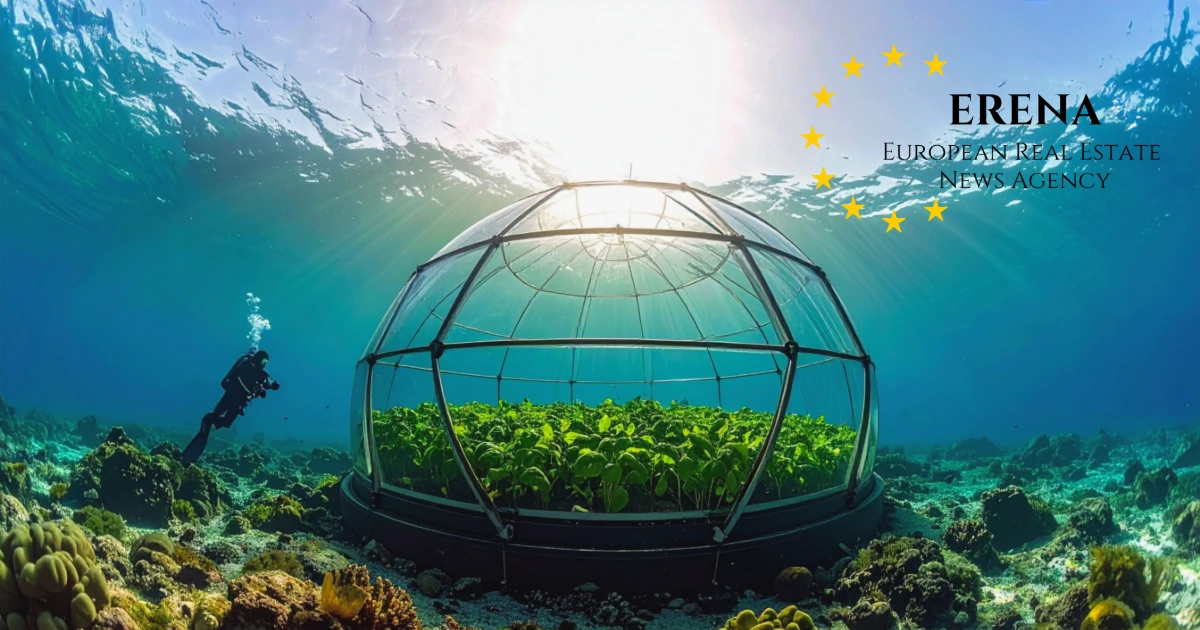
For more than a decade divers off the Ligurian coast have not only explored reefs but tended basil plants growing inside transparent domes anchored to the seabed. The project officially known as Nemo’s Garden has operated near Noli in Italy since 2012 and is widely described as the world’s first underwater greenhouse system. What began as an engineering experiment has evolved into a long-running research platform testing whether agriculture can function beneath the Mediterranean Sea under stable controlled conditions.
A Greenhouse Beneath the Surface
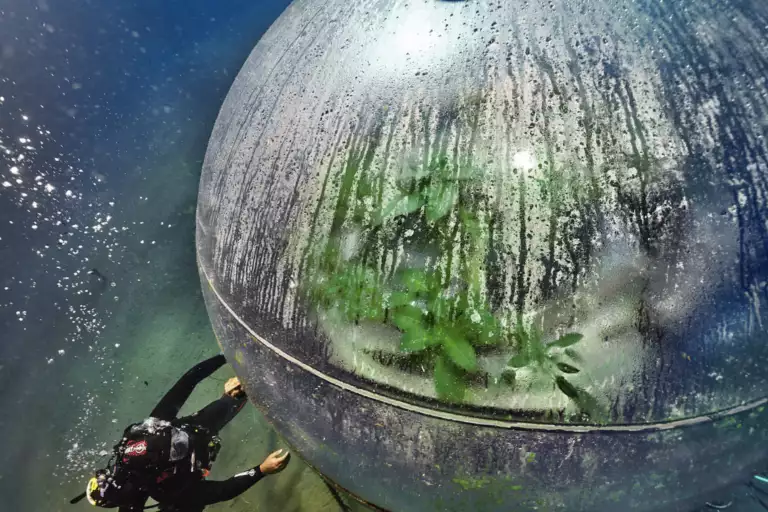
The biospheres are installed at depths of approximately 6 to 11 metres and function as sealed air-filled greenhouses underwater. Each transparent dome traps a humid microclimate while the surrounding sea stabilises temperature fluctuations. Sunlight penetrates the water and warms the air inside, producing condensation that is collected and reused as irrigation water. Crops grow hydroponically without soil, and environmental data on temperature, humidity and air composition is transmitted to shore-based systems.
The system was developed by the Italian company Ocean Reef Group under the leadership of engineer Sergio Gamberini. The objective was not industrial-scale food production but the exploration of alternative cultivation systems for coastal regions where arable land and freshwater are increasingly constrained.
Engineering Inside the Biosphere
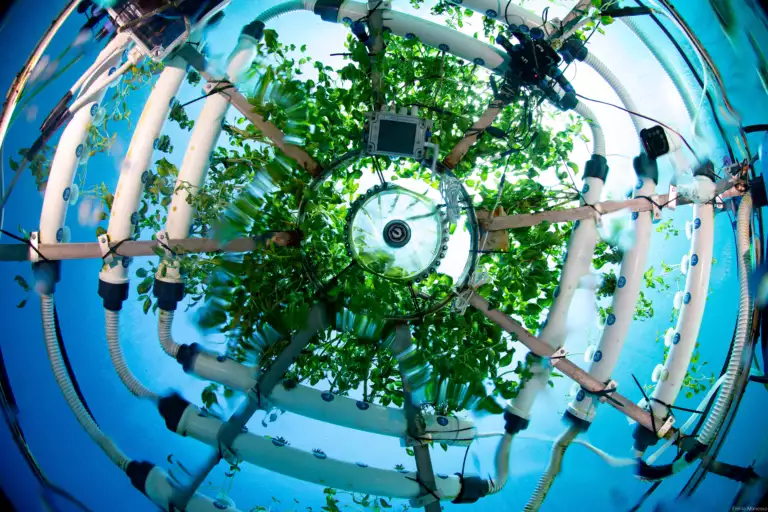
Inside each dome the structure resembles a compact circular laboratory rather than a conventional farm. Irrigation tubes, plant holders and monitoring devices form a closed system designed for precision rather than volume. The surrounding sea acts as a natural thermal buffer, while stable underwater pressure influences plant physiology. Researchers analyse how these marine variables affect growth cycles, chemical composition and aromatic intensity compared with standard greenhouse cultivation.
Nemo Garden operates as a controlled environmental research site focused on plant response and system optimisation rather than large-scale agricultural output.
Crops and Scientific Evidence
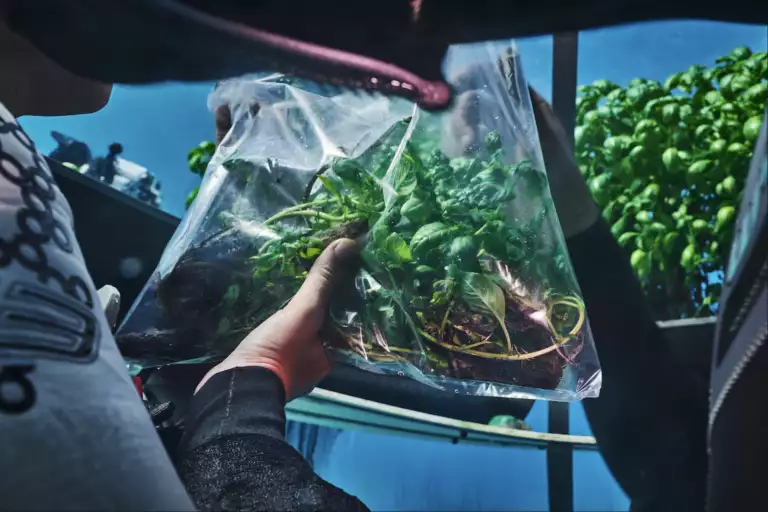
Basil became the flagship crop due to its cultural importance in Liguria and its sensitivity to environmental variation. Over time tomatoes, beans, lettuce, herbs, flowers and strawberries have also been cultivated inside the biospheres. Comparative scientific research on underwater grown basil has identified measurable differences in aromatic compounds and antioxidant profiles, indicating that the marine microclimate produces distinct biological responses rather than simply replicating traditional greenhouse conditions.
These findings position Nemo Garden as a niche platform for specialty crops and botanical experimentation. Instead of replacing conventional agriculture, it explores how controlled marine environments might support high-value cultivation or climate-resilient farming strategies.
Infrastructure and the 2025 Upgrade
Ahead of the 2025 growing season the project underwent one of its most significant technical upgrades, including redesigned cabling, reinforced structural connections and improved environmental safeguards. Installations exposed to marine currents, salt corrosion and biofouling require continuous engineering reinforcement. Expansion therefore depends on durability and system optimisation rather than increased cultivation area.
Production volumes remain limited and commercial distribution minimal. The emphasis remains on technological refinement and long-term feasibility rather than immediate scale.
Tourism and Public Pricing
The clearest visible market price associated with Nemo Garden relates to tourism. Local operators near Noli promote snorkeling excursions around the biospheres from approximately 40 euros per person, while scuba diving experiences in the same coastal zone are marketed from around 75 euros per dive. Visitors are not permitted to enter the sealed research domes, but the installation has become a distinctive marine attraction generating indirect regional economic activity.
Vision and Economic Reality
Media coverage has compared the biospheres to a miniature space station beneath the sea, highlighting both the ambition and engineering complexity of the concept. Agricultural specialists generally regard the model as innovative yet limited in scale. Underwater cultivation is unlikely to replace land-based farming, but it may offer resilience applications for regions facing land scarcity, drought or climate volatility.
After more than fourteen years Nemo Garden has demonstrated that terrestrial crops can be cultivated underwater in stable controlled environments. The remaining challenge is economic scalability. Infrastructure is specialised, installation requires marine expertise and operational costs remain higher than those of conventional agriculture. As climate adaptation pressures intensify, experimental coastal agriculture may gradually move from technological curiosity to strategic research frontier beneath the Mediterranean surface.