
One of Nuremberg’s most complex redevelopment projects has entered a quieter but more decisive phase. With TÜV SÜD Advimo assuming full responsibility for property management at The Q, attention shifts away from construction timelines and financing structures toward long-term operation. This transition signals that The Q is no longer treated as a project in flux, but as infrastructure expected to perform reliably within the city’s administrative and economic system.
The site along Fürther Straße carries deep industrial roots. Built in the 1950s as part of the Quelle mail-order empire, the complex once embodied scale, efficiency and post-war economic confidence. When logistics models evolved and industrial activity moved elsewhere, the buildings remained — large, centrally located and increasingly detached from the city’s needs. For years, the challenge was not whether to redevelop the area, but how to do so without turning it into another isolated commercial enclave.
Reprogramming scale rather than erasing it
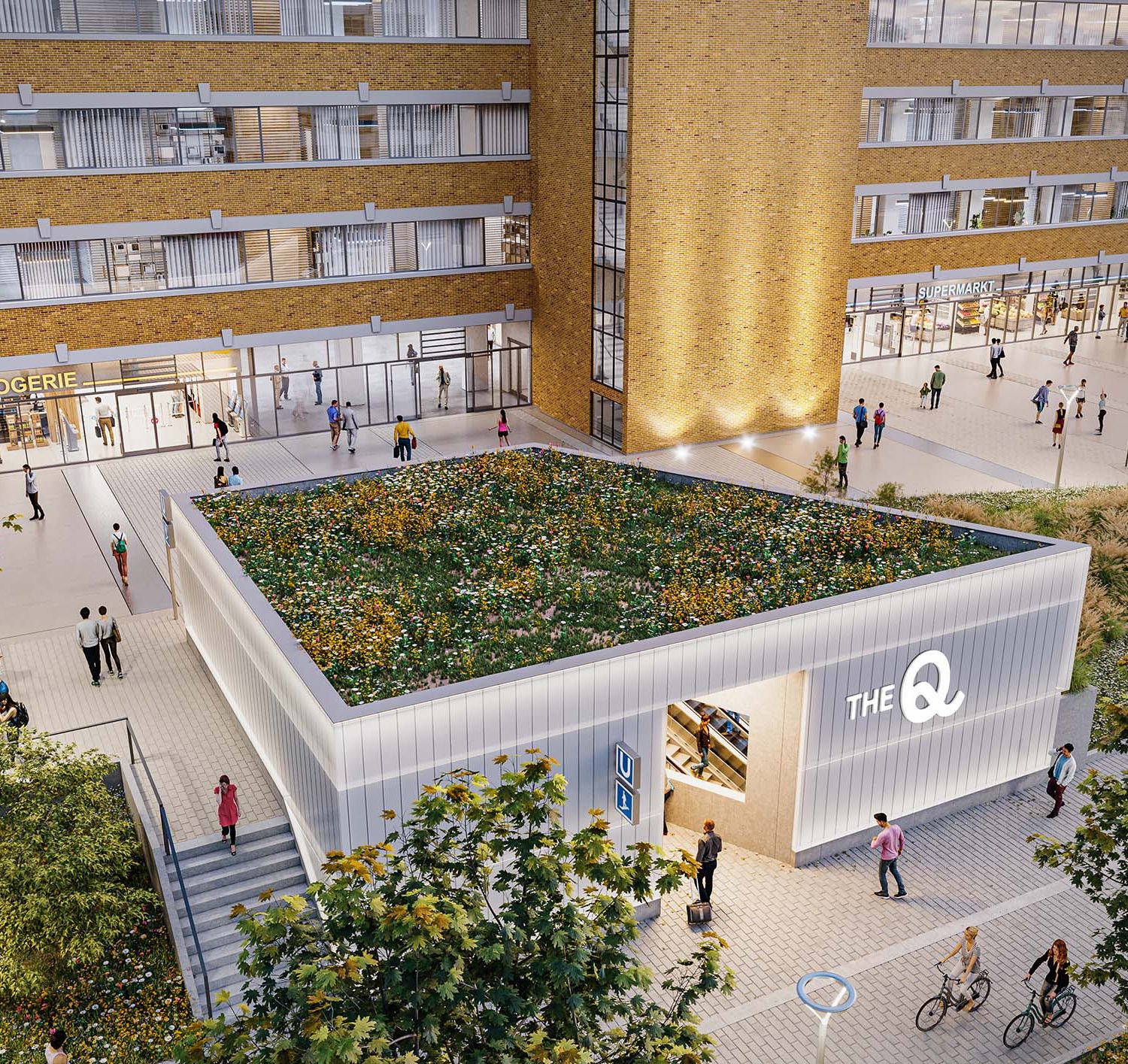
The strategy behind The Q deliberately avoids a clean-slate approach. Instead of demolition, the existing structures are being reprogrammed into a mixed-use complex of roughly 60,000 square metres, combining office space, retail, gastronomy and publicly accessible areas. At the heart of the project sits Stadthaus Q, a new municipal administration centre designed to consolidate key city departments that were previously scattered across multiple locations.

This public anchor fundamentally reshapes the project’s risk profile. Long-term municipal occupancy stabilises demand and reframes The Q as civic infrastructure rather than a speculative real estate venture. The ambition is not simply to deliver square metres, but to reintegrate a former industrial site into the everyday functioning of the city, both economically and administratively.
Why operations now matter more than architecture
Once cranes disappear, projects like The Q are judged less by architectural intent and more by daily performance. Heating systems, security protocols, maintenance cycles, energy efficiency and tenant coordination become the silent determinants of success or failure.
In this phase, professional property management stops being a background service and becomes the backbone of the asset. This is where TÜV SÜD Advimo’s role becomes central. Its mandate covers both technical and commercial management, including building systems, safety and regulatory compliance, energy performance, tenant relations and day-to-day operational processes. The objective is not merely to keep the complex running, but to ensure predictable costs, uninterrupted functionality and long-term usability for public administration and private tenants alike.

Advimo operates within the broader TÜV SÜD, internationally associated with inspection, certification and technical risk management. That background brings a lifecycle-oriented mindset to property operations, prioritising resilience, preventive maintenance and regulatory foresight over short-term optimisation. For assets that combine public administration, commercial activity and open urban space, this approach reduces operational risk over decades rather than years.
Recovery credibility and what The Q represents
The Q’s development has not followed a smooth trajectory. Financial difficulties and an insolvency process in 2023 interrupted progress and raised doubts about the project’s long-term viability. Restarting development required more than new financing; it required a visible reset in governance and operational credibility. Appointing an institutionally recognised property manager was therefore as much a signal as a solution.
Projects emerging from restructuring often struggle with trust. Uncertainty around maintenance standards, operating costs and long-term commitment can linger long after construction resumes. By placing The Q under professional management, those risks are contained. For the City of Nuremberg, set to become the anchor tenant, the shift reduces both operational exposure and political risk, replacing crisis management with predictable long-term occupation.
Beyond Nuremberg, The Q reflects a broader shift in how German cities approach large redevelopment schemes. The emphasis is moving away from headline construction milestones toward governance, operational efficiency and lifecycle performance — a response to higher financing costs and tighter public budgets. Cities have little tolerance for assets that look impressive at opening but prove expensive or unreliable to run.
For Nuremberg, The Q is ultimately a test case. If it works as intended, it demonstrates that industrial heritage can be converted into functional civic infrastructure without becoming a long-term liability. With TÜV SÜD Advimo now overseeing operations, the project has moved beyond redevelopment and into the more demanding, less visible phase of permanent city life.