
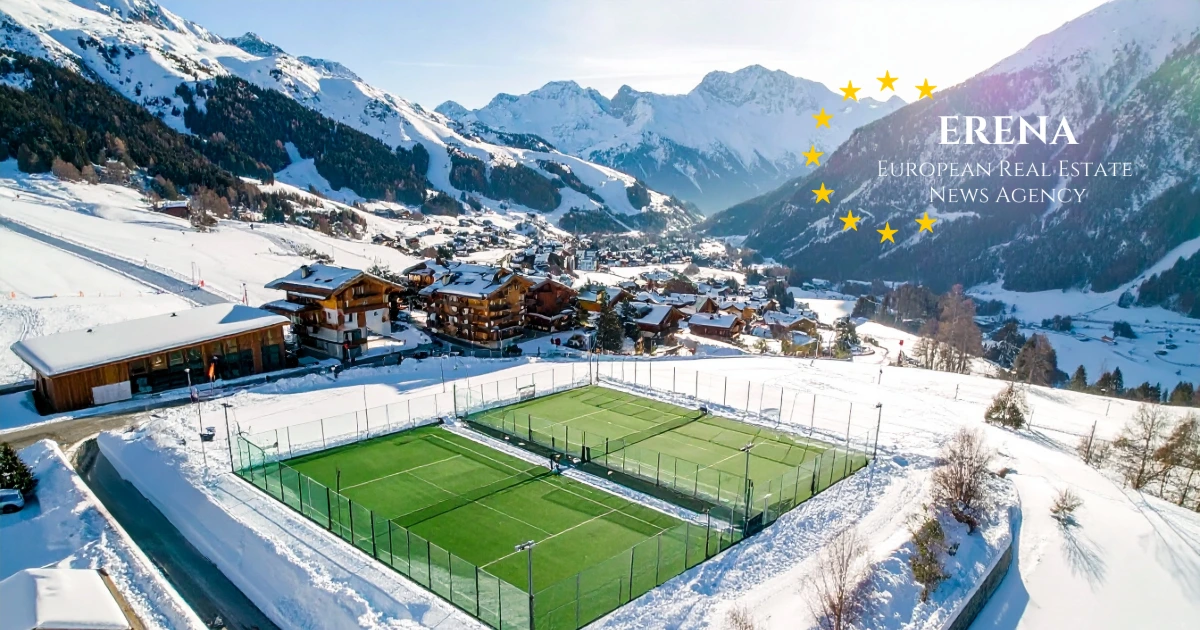
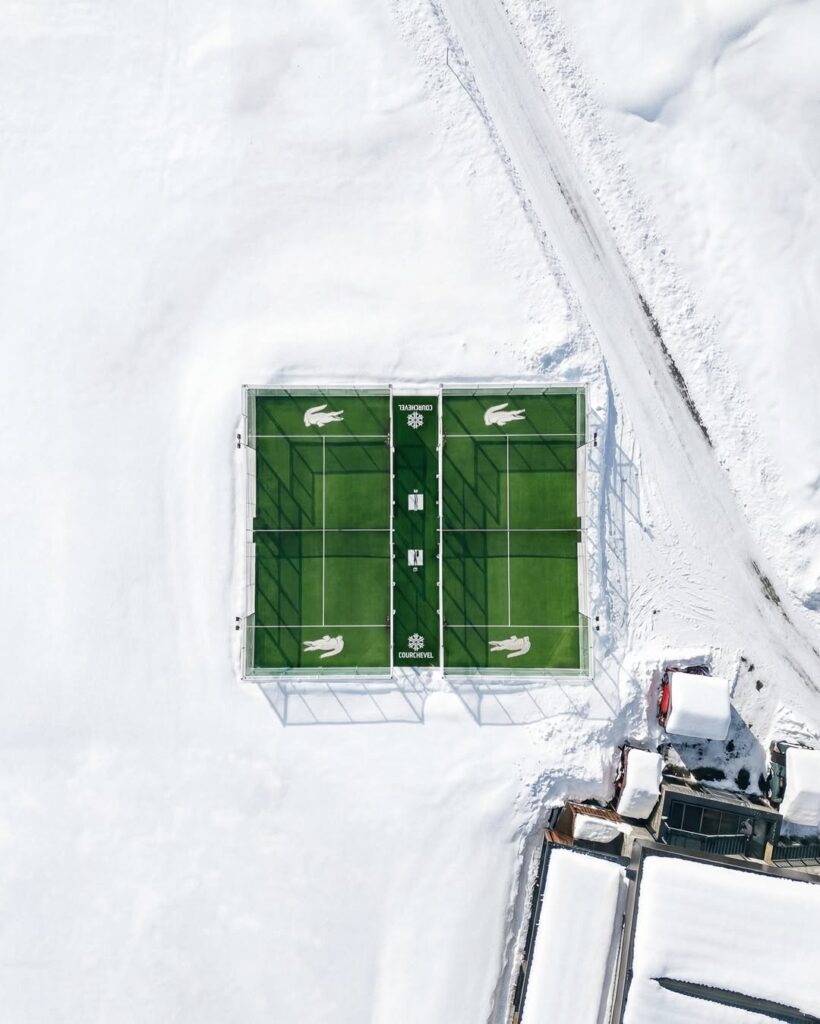
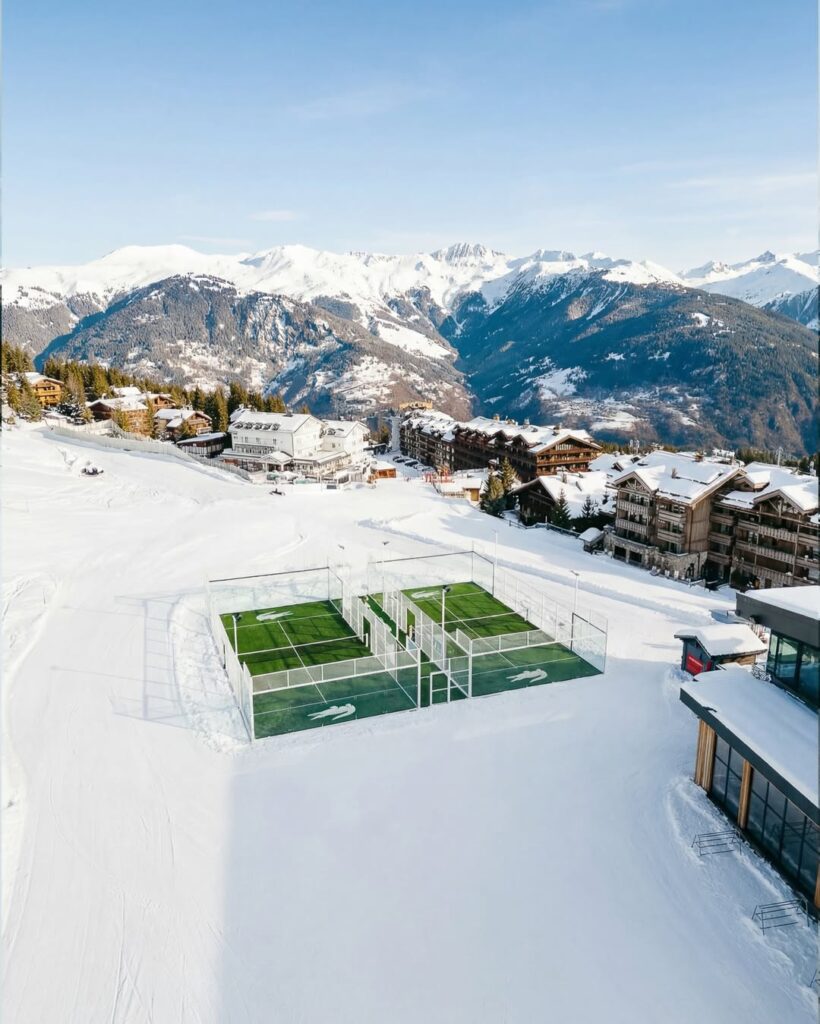
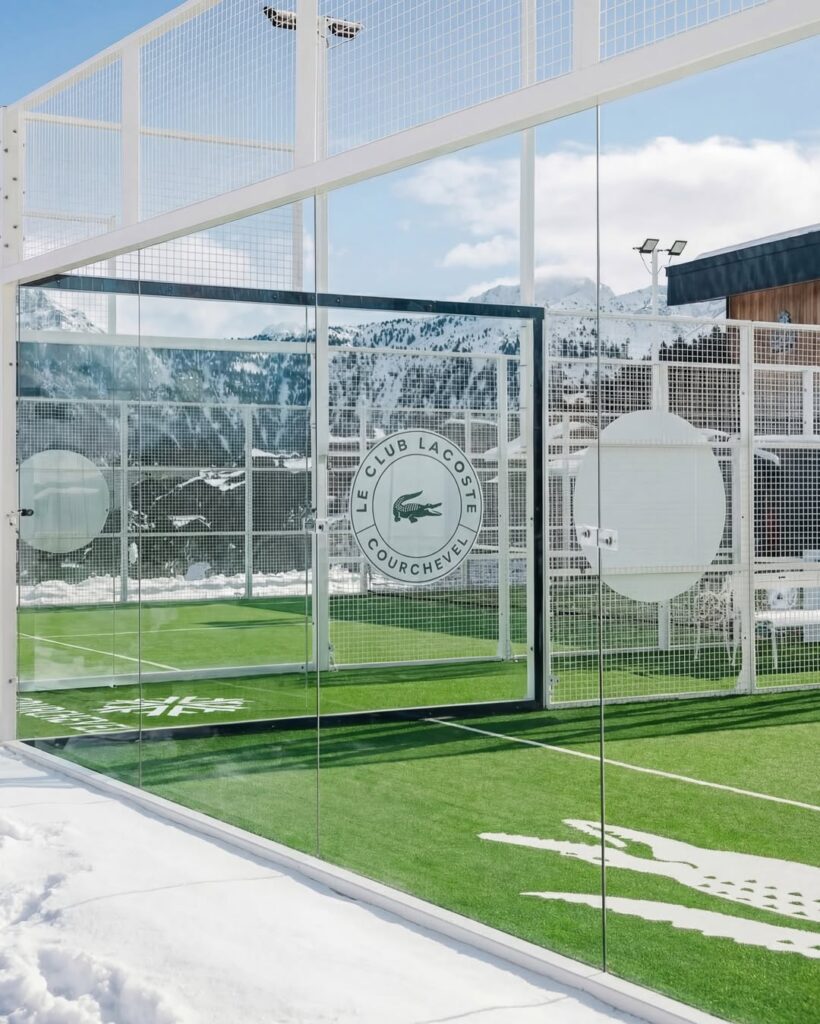
The opening of two Lacoste-branded padel courts in Courchevel 1850 this winter looks, at first glance, like a lifestyle footnote — a fashionable sport inserted into an already saturated luxury resort. In reality, it reflects something much deeper: a shift in how Alpine destinations are rethinking their economic model in response to climate uncertainty, changing travel behaviour and the limits of ski-centric growth.
For decades, the financial logic of mountain resorts was straightforward. Snow brought skiers, skiers brought occupancy, and occupancy drove the rest of the local economy. That logic is now under strain. Warmer winters, volatile snowfall patterns, rising energy costs and changing consumer expectations have weakened the assumption that skiing alone can sustain year-round profitability. Resorts are therefore looking for ways to extend not only their season, but their economic day — to create activities that absorb time, attention and spending outside the narrow window of peak ski hours.
From ski resort to experience ecosystem
Padel fits into that strategy unusually well. It is accessible, social, fast to learn and naturally group-based. It requires far less technical commitment than tennis, far less physical endurance than skiing, and far less space than most traditional sports infrastructure. That makes it ideal for a tourist setting where visitors want something active, but not exhausting, and something social, but still premium.
In Courchevel, the courts are placed not in a peripheral leisure zone but directly at the base of the Émile Allais slalom stadium — the symbolic heart of competitive skiing in the resort. This is not accidental. By positioning padel alongside skiing rather than beneath it, the resort is signalling that its future is not built on replacing the mountain, but on layering new experiences onto it.
The economic logic behind small sports infrastructure
From an economic perspective, this matters. Skiing is capital-intensive, weather-dependent and seasonal. Padel is comparatively cheap, programmable and resilient. A ski lift earns money when it runs and when snow exists. A padel court earns money when people book it — for private sessions, coaching, events, brand activations or casual play — and it can do so across seasons, weather conditions and time slots that skiing cannot reach.
For the visitor, the cost is marginal. Against a background of ski passes, accommodation and fine dining, a paid padel session is psychologically small — an impulse rather than a decision. For the resort, however, it is incremental revenue with high utilisation potential and low operational complexity. This asymmetry is exactly what makes such installations attractive.
Why Lacoste is investing in place not just promotion
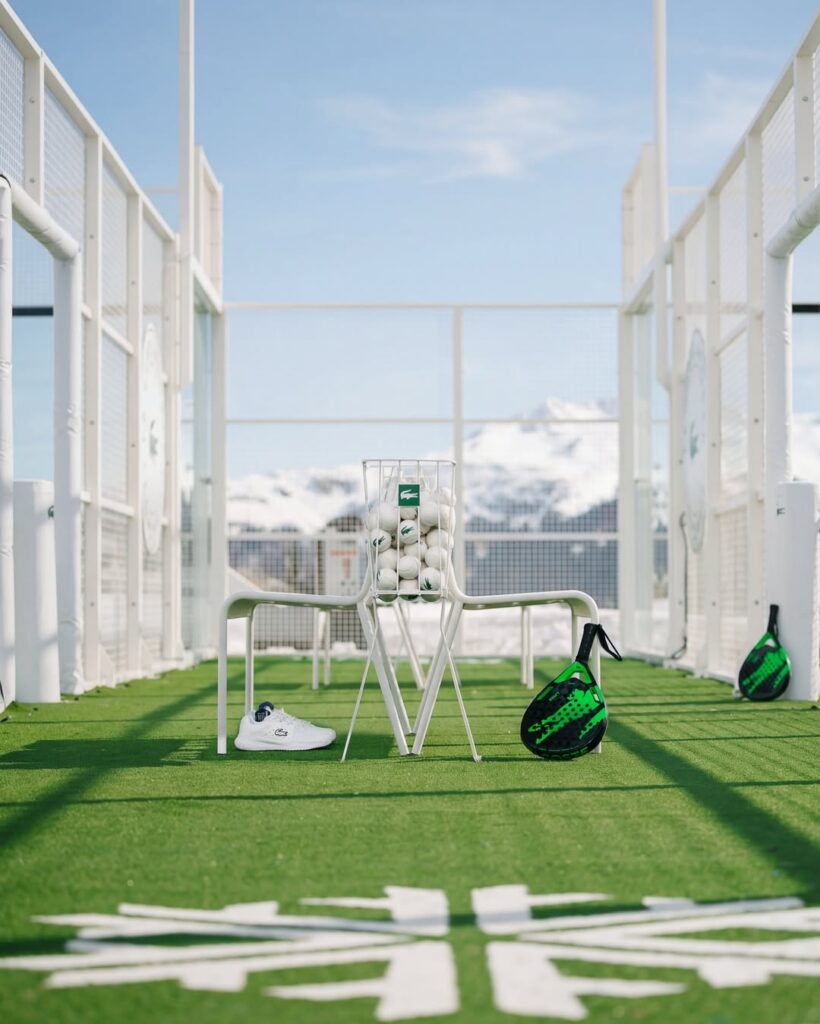
Lacoste’s involvement reveals a parallel transformation in luxury branding. Historically, sports brands attached themselves to events, athletes or federations. Increasingly, they are attaching themselves to places. A branded court is not advertising; it is infrastructure. It creates repeated contact between brand and consumer through time spent, activity performed and social memory formed.
Courchevel is particularly valuable in this regard because it functions as a global luxury signal rather than a mass market destination. Presence there does not generate volume, but it generates positioning. It aligns the brand with affluence, exclusivity and a specific type of consumer who values status through experience rather than ownership alone.
Resorts and brands are converging on the same objective
The deeper logic is that both resorts and brands are converging on the same objective: control of context. Resorts want control over more of the visitor’s day. Brands want control over more of the consumer’s experience. A padel court sits exactly at that intersection.
The strategic significance is therefore not about padel itself, but about what padel represents. It represents a move away from mono-functional destinations towards layered platforms of activity, identity and consumption. It represents a shift from seasonal economics to continuous engagement.
The next phase for Alpine resort development
If Courchevel’s experiment succeeds, it will not remain isolated. Other Alpine resorts face the same structural pressures and will look for similarly flexible, scalable tools to diversify their offer. Padel is unlikely to be the last of these. Wellness, indoor training, digital experiences and hybrid sport-entertainment formats are likely to follow.
What is changing is not what people do in the mountains, but why the mountains exist economically. They are no longer just places to ski. They are becoming experience ecosystems, and every new court, studio, arena or platform is a building block in that transition.
In that sense, two glass-walled padel courts at the foot of a slalom stadium are not a curiosity. They are a signal — quiet, but precise — of how even the most tradition-heavy destinations are redesigning themselves for a world in which snow alone is no longer enough.